Before Brooke Shields took an elongated tour down mediocre lane, she appeared in at least one good flick: Louis Malle's Pretty Baby (1978). The film, which was released under a mass amount of controversy, centers around Violet (Brooke Shields) and her life in a 1917 New Orleans brothel. As this was 1917, there is little puritanical virtue embedded into the lives of the prostitutes or young Violet. All of the women, including Violet's mother, Hattie (Susan Sarandon), enjoy their work and relish the company of the other prostitutes. Violet is entranced by her surroundings and leaps for joy when her virginity is auctioned off to the highest bidder. But it's not all peaches and cream. There's an odd, disquieting sensation felt throughout the entirety of Pretty Baby that leaves an aching, lingering feeling in your gut after the film ends. Could it be happiness? Few films deal with sexual encounters as openly and maturely as Malle does with Pretty Baby and his treatment of Shields' and the world's oldest profession never feels gratuitous or cheap. It's certainly one of my favorite films. One can only hope that Criterion saves it from Paramount hell in the near future.
Thursday, January 29, 2009
Pretty Baby (1978)
Before Brooke Shields took an elongated tour down mediocre lane, she appeared in at least one good flick: Louis Malle's Pretty Baby (1978). The film, which was released under a mass amount of controversy, centers around Violet (Brooke Shields) and her life in a 1917 New Orleans brothel. As this was 1917, there is little puritanical virtue embedded into the lives of the prostitutes or young Violet. All of the women, including Violet's mother, Hattie (Susan Sarandon), enjoy their work and relish the company of the other prostitutes. Violet is entranced by her surroundings and leaps for joy when her virginity is auctioned off to the highest bidder. But it's not all peaches and cream. There's an odd, disquieting sensation felt throughout the entirety of Pretty Baby that leaves an aching, lingering feeling in your gut after the film ends. Could it be happiness? Few films deal with sexual encounters as openly and maturely as Malle does with Pretty Baby and his treatment of Shields' and the world's oldest profession never feels gratuitous or cheap. It's certainly one of my favorite films. One can only hope that Criterion saves it from Paramount hell in the near future.
Wednesday, January 7, 2009
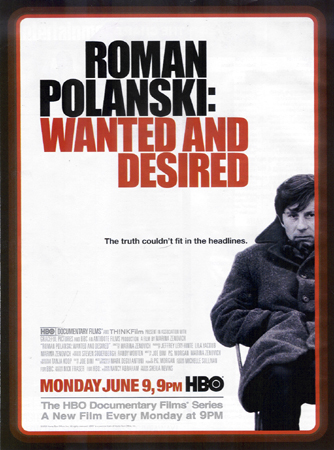
Roman Polanski: Wanted and Desired
This review was also published in Sadie Magazine .
When I was twelve years old, my father introduced me to the work of Roman Polanski by showing me his most heralded film, Chinatown (1974). Though I couldn’t articulate it at the time, I was intensely attracted to the seedy, pessimistic vibe of it all—a vibe I would later come to know as the luminescent pulse that surges through the very flesh of almost every Polanski creation. Upon investigating more of his films and reading his wonderful autobiography, Roman by Polanski, I knew that Polanski, more than any other filmmaker I’d previously known or have known since, was my true cinematic soul mate. We share the same demons, desires, and, most importantly—at the risk of sounding corny—the same knack for survival and perseverance.
These four character traits are also the most common themes running throughout Polanski’s work. Out of the seventeen feature films he has made, nearly all of them present a character—from Oliver Twist (Oliver Twist) to Rosemary Woodhouse (Rosemary's Baby)—who is thrown into a life or death situation and forced to dig him/herself out at any cost. More often than not, this cost becomes the central question for the characters within these narratives. How much does Rosemary want to have a child? How badly does Wladyslaw Szpilman (The Pianist) want to survive, and why? How much is the truth worth to J.J. Gittes (Chinatown)? The questions, like the answers, go on and on.
It’s not terribly puzzling to surmise where these large questions come from. Until recently, Polanski’s life seems to have represented one questionable tragedy after another. As a young lad in Poland, he was left to fend for himself after both of his parents were shipped off to concentration camps. And, after the war was finally over, only his father returned. In 1969, Polanski’s wife, the strikingly beautiful and sweet Sharon Tate, was murdered by the hands of the Manson family.
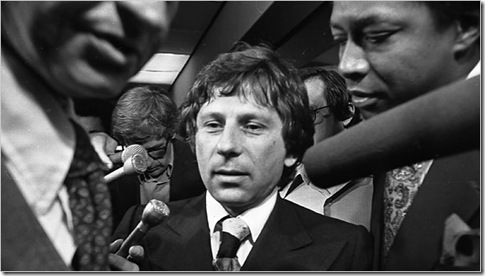
And, in 1978, Roman Polanski fled to France from the United States to avoid a fifty-year jail sentence for having sexual intercourse with a minor, Samantha (Gailey) Geimer. He had been commissioned by a French fashion magazine to do a photo shoot of young women and hired Ms. Geimer to be one of his models. The sexual act occurred during their second photo session at the home of Jack Nicholson in March of 1977.
The circumstances of the situation still remain mysterious. We now know that champagne and Quaaludes were involved, and that Polanski was charged with six felony crimes. This includes child molestation and sodomy, both of which were eventually pleaded down to a single misdemeanor of unlawful sexual conduct with a minor. Samantha Geimer has gone on the record multiple times since then telling the world that she has forgiven Polanski and that his work should not be impugned because of this one instance in his life. But, the truth is, despite creating a mélange of brilliant films since, like Tess (1979), Bitter Moon (1992), and the painfully unseen Oliver Twist (2005), Polanski’s artistic credibility has diminished in our country’s eyes because of it.

And, due to a thick haze of courtroom drama and mountains of obstructing paperwork, the details of the case were inaccessible to the public eye. This made it very easy for the bulk of the nation to look at this very complex situation with a black and white lens. You can’t sell anything as complex as the truth. It’s much easier to call “child molester” and watch the magazines fly off the rack.
In the recent documentary, Roman Polanski: Wanted and Desired, filmmaker Marina Zenovich explores the netherworlds of this event and reveals that much of the agitation surrounding Polanski’s unique case was caused by the media-hungry Judge Laurence J. Rittenband, then notorious high-profile celebrity trials for his own ends. Though the case never officially went to trial, Rittenband often intentionally fed the media dynamic half-truths in order to both increase his own publicity and cloud the facts surrounding the case. Like a twisted magician, Rittenband created drama where there was none.
For instance, in the midst of the Polanski/Geimer madness, he staged a fake court session with each of the lawyers for the press, even though all of the players already knew the outcome. He was also the first judge to actually hold a press conference in his chambers. Through all this perplexing controversy, Polanski and Geimer reached an amiable plea bargain shortly after the preliminary hearings. The simple truth was that they both wanted to move on. Unfortunately for Polanski, Rittenband didn’t.
Though, initially, Rittenband honored their mutual decision, it wasn’t long before he succumbed to the controversy-starved media and reneged on his word. As Geimer says in the documentary: “Who wouldn’t think about running when facing a fifty-year sentence from a judge who was clearly more interested in his own reputation than a fair judgment or even the well-being of the victim?”
Zenovich not only does an immaculate job of sifting out the dirt of the case, she also does the near impossible: she attempts objective documentary filmmaking. Utilizing interviews with nearly everyone involved, a treasure trove of rare archive footage, and even clips from Polanski’s films, Zenovich accurately and patiently tells both sides of the story while simultaneously maintaining the non-judgmental eye required for such delicate material. She neither victimizes nor demonizes Polanski and Geimer. Instead, she treats her cinematic subjects as people, as living, intelligent beings that deserve to finally have their voices heard and recognized.
By providing this outlet for all of the players (except Polanski himself, as he doesn’t want to drudge up the past) in this epic saga, Zenovich has successfully created a nail-biting account of one of the most public media frenzies of the twentieth century. This documentary is smart and subtle and never relents on telling the whole truth, even if some of the details might make you uncomfortable. Zenovich doesn’t judge, and because of that, she has created one of the best documentaries of the past decade.
**Note** - As of last month, Polanski made the initial motions to get the thirty year old case thrown out of court, citing this documentary as enough evidence to put him in the clear. I love cinema.
When I was twelve years old, my father introduced me to the work of Roman Polanski by showing me his most heralded film, Chinatown (1974). Though I couldn’t articulate it at the time, I was intensely attracted to the seedy, pessimistic vibe of it all—a vibe I would later come to know as the luminescent pulse that surges through the very flesh of almost every Polanski creation. Upon investigating more of his films and reading his wonderful autobiography, Roman by Polanski, I knew that Polanski, more than any other filmmaker I’d previously known or have known since, was my true cinematic soul mate. We share the same demons, desires, and, most importantly—at the risk of sounding corny—the same knack for survival and perseverance.
These four character traits are also the most common themes running throughout Polanski’s work. Out of the seventeen feature films he has made, nearly all of them present a character—from Oliver Twist (Oliver Twist) to Rosemary Woodhouse (Rosemary's Baby)—who is thrown into a life or death situation and forced to dig him/herself out at any cost. More often than not, this cost becomes the central question for the characters within these narratives. How much does Rosemary want to have a child? How badly does Wladyslaw Szpilman (The Pianist) want to survive, and why? How much is the truth worth to J.J. Gittes (Chinatown)? The questions, like the answers, go on and on.
It’s not terribly puzzling to surmise where these large questions come from. Until recently, Polanski’s life seems to have represented one questionable tragedy after another. As a young lad in Poland, he was left to fend for himself after both of his parents were shipped off to concentration camps. And, after the war was finally over, only his father returned. In 1969, Polanski’s wife, the strikingly beautiful and sweet Sharon Tate, was murdered by the hands of the Manson family.
And, in 1978, Roman Polanski fled to France from the United States to avoid a fifty-year jail sentence for having sexual intercourse with a minor, Samantha (Gailey) Geimer. He had been commissioned by a French fashion magazine to do a photo shoot of young women and hired Ms. Geimer to be one of his models. The sexual act occurred during their second photo session at the home of Jack Nicholson in March of 1977.
The circumstances of the situation still remain mysterious. We now know that champagne and Quaaludes were involved, and that Polanski was charged with six felony crimes. This includes child molestation and sodomy, both of which were eventually pleaded down to a single misdemeanor of unlawful sexual conduct with a minor. Samantha Geimer has gone on the record multiple times since then telling the world that she has forgiven Polanski and that his work should not be impugned because of this one instance in his life. But, the truth is, despite creating a mélange of brilliant films since, like Tess (1979), Bitter Moon (1992), and the painfully unseen Oliver Twist (2005), Polanski’s artistic credibility has diminished in our country’s eyes because of it.
And, due to a thick haze of courtroom drama and mountains of obstructing paperwork, the details of the case were inaccessible to the public eye. This made it very easy for the bulk of the nation to look at this very complex situation with a black and white lens. You can’t sell anything as complex as the truth. It’s much easier to call “child molester” and watch the magazines fly off the rack.
In the recent documentary, Roman Polanski: Wanted and Desired, filmmaker Marina Zenovich explores the netherworlds of this event and reveals that much of the agitation surrounding Polanski’s unique case was caused by the media-hungry Judge Laurence J. Rittenband, then notorious high-profile celebrity trials for his own ends. Though the case never officially went to trial, Rittenband often intentionally fed the media dynamic half-truths in order to both increase his own publicity and cloud the facts surrounding the case. Like a twisted magician, Rittenband created drama where there was none.
For instance, in the midst of the Polanski/Geimer madness, he staged a fake court session with each of the lawyers for the press, even though all of the players already knew the outcome. He was also the first judge to actually hold a press conference in his chambers. Through all this perplexing controversy, Polanski and Geimer reached an amiable plea bargain shortly after the preliminary hearings. The simple truth was that they both wanted to move on. Unfortunately for Polanski, Rittenband didn’t.
Though, initially, Rittenband honored their mutual decision, it wasn’t long before he succumbed to the controversy-starved media and reneged on his word. As Geimer says in the documentary: “Who wouldn’t think about running when facing a fifty-year sentence from a judge who was clearly more interested in his own reputation than a fair judgment or even the well-being of the victim?”
Zenovich not only does an immaculate job of sifting out the dirt of the case, she also does the near impossible: she attempts objective documentary filmmaking. Utilizing interviews with nearly everyone involved, a treasure trove of rare archive footage, and even clips from Polanski’s films, Zenovich accurately and patiently tells both sides of the story while simultaneously maintaining the non-judgmental eye required for such delicate material. She neither victimizes nor demonizes Polanski and Geimer. Instead, she treats her cinematic subjects as people, as living, intelligent beings that deserve to finally have their voices heard and recognized.
By providing this outlet for all of the players (except Polanski himself, as he doesn’t want to drudge up the past) in this epic saga, Zenovich has successfully created a nail-biting account of one of the most public media frenzies of the twentieth century. This documentary is smart and subtle and never relents on telling the whole truth, even if some of the details might make you uncomfortable. Zenovich doesn’t judge, and because of that, she has created one of the best documentaries of the past decade.
**Note** - As of last month, Polanski made the initial motions to get the thirty year old case thrown out of court, citing this documentary as enough evidence to put him in the clear. I love cinema.
Monday, January 5, 2009
Changeling
“That’s not my son.” - Christine Collins
In March of 1928, a single mother named Christine Collins (Angelina Jolie) arrives home from her work to find that her young and only son, Walter (Gattlin Griffith) is nowhere to be found. Following a five-month investigation with nothing but dead ends, the fuzz (LAPD) tells Christine that they have finally found Walter. But it’s not him. In order to save face, they guilt-trip Christine into taking care of the imposter and give up looking for the real Walter Collins. Christine, along with a few other kind (male) patrons, including John Malkovich’s Rev. Briegleb, conducts her own investigation and uses the testicular fortitude surrounding her to uncover the truth and deliver justice.
The woes and foes of motherhood are not easily imitated on screen. A mother’s role, like that of the many waitresses, nurses, teachers, and secretaries who keep our society afloat, are poorly represented in cinema because of the so-called humdrum nature of their job. After all, who wants to watch a movie about someone’s mother unless they’re a serial killer and/or prostitute on the side? What’s truly dramatic about raising children if there’s no seedy underbelly? In other words, motherhood needs be stranger than fiction to make the cinematic cut.
Changeling, though it definitely has a seedy underbelly, is ultimately a movie about motherhood and its hardships. Like the best flicks about mothers, such as the tearjerker classic, Stella Dallas, and Almodovar’s fizzy Spanish delights, All About my Mother and Volver, Changeling almost sacrificially surrounds its narrative with women’s issues and plights. However, unlike its predecessors, Changeling misses the motherly beat because of the specimen-under-glass mentality it delivers in showcasing the dilemma of Christine Collins. Or, in other words, the film may comprehend what Christine is going through at a distance, but it’s too afraid to explore her character any further than its surface-level meanderings. What we eventually come to know about Christine is what the other male characters have told us because she won’t open her mouth to tell us herself.
As both an actor and a director, Clint Eastwood is notorious for creating and embodying some of the strongest male characters on screen since the late 1950’s. Almost all of them, from the Man with No Name to Dirty Harry, are independent, resourceful, and for the most part, immortal. The same cannot be said for his female characters, who are both single-minded and bodied creations, kind of like aliens in better clothes instead of equal members of society. Eastwood just can’t seem to separate himself or his maleness away from the camera lens. In both Million Dollar Baby and Changeling, Eastwood polarizes his potentially powerful female leads into nothing more than vessels for the male perspective. Eastwood may be able to comprehend the inherent struggle of his women’s films and their characters, but he’s about as appreciative and understanding of their souls as The Man with No Name is of Tuco’s lust for gold in The Good, The Bad, and The Ugly - which isn’t much.
If Changeling had been harnessed by a more emotionally involved filmmaker, I’m sure Christine Collins and her amazing story would have been far more empowering. As it stands now, Eastwood’s Changeling is nothing more than a beautifully empty portrayal of motherhood and its ghost stories.
Labels:
Angelina Jolie,
Changeling,
Clint Eastwood,
Motherhood
Saturday, November 22, 2008
Four Minutes (Vier Minuten)
This review was also published at the Feminist Review.
Since the advent of sound entered the motion picture business in the 1920s, audiences have continually been fascinated with the bebop rhythm of music and its creators. Al Jolson, who uttered cinema’s initial words (“…you ain’t heard nothin’ yet!”) was the first to be tackled by Hollywood’s dream machine. Next came the likes of Gershwin, Miller, and Porter. Busby Berkeley made violins out of the figures of women who danced to jazz numbers. Dorothy Arzner, one of Hollywood’s only feminist filmmakers, directed Dance, Girl, Dance. Soon enough, MGM’s innovative Freed unit followed suit and produced spectacular musicals with Gene Kelly and Fred Astaire. Music truly brought magic to the movies. Well, at least until the 1970s when the studio system collapsed and Hollywood took every ounce of musical cinema down with it. Today, musicals have dwindled down to the most inane form of entertainment: the bio-pic. Movies like Ray, Walk the Line, DreamGirls, and Moulin Rouge have all but ruined the movie musical with their tired narrative formulas and unimaginative aesthetics.
There are many grave misfortunes that go hand in hand with the reality of an over-commercialized film industry. One of the primary aspects is that there really are a few films released each year that are worth our attention. But we never get to see them on any sort of a mass scale because we’re too busy being bombarded with the latest blockbuster. However, I recently had the privilege to view one of those elite flicks, a German film called Four Minutes (Vier Minuten) that, thankfully, proves me wrong with its insane amount of passion, musical poise, and sincere subject matter.
Jenny, played immaculately by Hannah Herzsprung, is a convicted murderess serving out her sentence at an all-female prison in rural Germany. She was once a grand pianist who gave up her gift when her father began sexually abusing her as a teenager. Jenny is now a headstrong and irritable kook who has a devout need for self-expression in art, but is not able to access that kind of release until Mrs. Krueger (Monica Bleibtreau), an eighty-year old with a dark past, begins giving her piano lessons at the prison. Music becomes a source of freedom for both characters. It’s almost as if they’re only truly human while making beautiful music together.
There is a strange frenetic quality running through the veins of Four Minutes that will leave you feeling wonderfully disjointed by the film’s end. It doesn’t pull any typical punches. Like, when the main characters talk about their troubled past, neither the film or the other character stops to pay attention. Instead, these minor personal trifles are viewed as a small, necessary annoyance; something to get over with quickly so they can move onto what’s really important: the music; neither Nazism or sexual abuse can stand in its way. Four Minutes is a worthwhile modern musical because it embraces the power of the medium without losing itself entirely inside its own world. It’s a consciously musical film without being self-conscious.
Though discussing acting isn’t usually my forte when reviewing a film, I must make special note of Hannah Herzsprung’s performance as Jenny. She is remarkable because she makes a mostly monstrous person both realistic and heartbreaking. Passion and zest ooze out of her body language and speech. There are a few memorable images in the film - the plucking of a cigarette out of a dead person’s pocket, playing the piano with handcuffs on, and a dramatic musical finale in front of a huge audience - that stand out amongst the rest because of the sheer power and charisma of Herzsprung and her character. She has won several acting awards for this film, and if you see it, you’ll definitely understand why. I can’t wait to see more of her work.
Four Minutes is a rarity in contemporary cinema because it takes the passion and talent of its characters seriously. Instead of rigorously enforcing the narrative structure upon us with inane details and devices, the film freely takes flight in pure moments of cinema that tell us more about the characters and their thoughts than an expository scene that hits all of the right, but boring notes. If you have Four Minutes to spare, I sincerely recommend you track this film down as it is the best of the best of the now New German Cinema.
Tuesday, October 7, 2008
Catch-up Capsules
Married Life
This flick doesn’t really know where it wants to go. Melodrama? Dark Comedy? Family Drama? Every person in this star-studded ensemble with Chris Cooper, Patricia Clarkson, Rachel McAdams, and Pierce Brosnan seems to have a different idea. It’s one of those everyone-is-sleeping-with-everyone roller coasters that doesn’t deliver in any one department completely. And, despite teasing us audience members with delicious, juicy tidbits like poisoning wives, Oedipus complexes, and post WWII mentalities, the film’s tonally stilted environment fails to bring light to any sort of worthwhile message or theme.
…But Rachel McAdams does wear amazing clothes. And I love the Lana Turner blonde upsweep.
What Happens in Vegas
My friend and fellow writer, Alex Dowd, brought a recent trend in Hollywood comedies to my attention - the two part sour and one part sweet three-act structure. Basically, the first two-thirds of the movie depict all of the characters being absolutely deplorable to one another only to chase it all down with a spoonful of spicy sugar at the end. What Happens in Vegas falls into that category, only it happens to be much worse because 66% of the damn thing is dedicated to guilt-tripping Cameron Diaz for wanting to be a career woman. The remaining 33% is spent reiterating the first two parts of the movie with a sappy marriage proposal from Ashton Kutcher along with the hopeful prospects of being a homemaker and stay at home mom. Aw.
Mamma Mia!
I have an immense soft spot for musicals…especially those that have a mostly all-female cast, take place in Greece, and have an entire dance number (Yes, the dancing queen routine) that features hundreds upon hundreds of women of all ages getting their groove on together in the spirit of womanhood. What I thought would be a frivolous flit into musical territory turned out to have some rather liberal messages about marriage (life first, marriage second), growing older (do it gracefully), and even women in the workplace (it works!). Also, Meryl Streep rocks as the Mamma in her sexy sixties and further proves she's not going to quit working anytime soon.
Monday, September 29, 2008
Switchblades and Suffrage - The Femsploitation Films of Jack Hill
"It was easy for him because he really didn't believe it was comin', but it ain't gonna be easy for you, because you better believe it's comin'!"
Between 1970 and 1975, the second wave of the feminist movement was in full swing and making the most progressive strides of its generation. For the first time in history, schools of all shapes and sizes were supporting and acknowledging women’s sports because of the Title IX amendment passed by congress in 1972, feminist magazines were all the rage after the first issue of Ms. magazine debuted that same year, and, most importantly, the epic Roe vs. Wade trial granted women the right to safe, legalized abortions across the nation in 1973. Those five years were also the most prolific and groundbreaking for feminist film theory and criticism. For instance, two of the most innovative works of the movement, Laura Mulvey’s innovative essay, Visual Pleasure and Narrative Cinema, and Molly Haskell’s comprehensive book, From Reverence to Rape, were published in 1974 and 1975. Clearly, the topic of feminism was widespread across the American conscience. To this day, the entire feminist movement has never seen so many extensive leaps and bounds within such a short time span.
And, yet, while feminism ruled the newspapers, books, and colleges with the first ever women’s studies programs, there is a surprising lack of feminist cinema within this time frame. As this is, of course, the era in which male filmmakers like Martin Scorsese, Francis Ford Coppola, and Steven Spielberg got their start in the mainstream industry as well as their start in dominating the movie screens with their masculine-driven narratives. While the feminists stepped outside the home to fight the good fight, the males moved into it and largely took over the entertainment industry with a death grip that still clinches our minds and bodies today.
However, between 1973 and 1975, filmmaker Jack Hill defied the odds by being both a male filmmaker who makes feminist films and for doing it under the vague guise of the exploitation film genre, or in this case, the femsploitation genre. In three of his films, Coffy (1973), Foxy Brown (1974), and Switchblade Sisters (1975), filmmaker Jack Hill created feminist works of art that exhibit strong female characters who actually think and feel like human beings. Not only that, but Hill also managed to weave narratives around these female characters that closely resemble a lot of the happenings and sensibilities of the feminist movement, like the battle between NAWSA and the NWP during the first wave of feminism in the early teens and the anti-lesbian mentality of feminists everywhere in the second wave. During the male-dominated cinema years of the early 1970’s, Jack Hill wrote and directed films with female characters and situations that ring true to the feminist feelings of the time period.
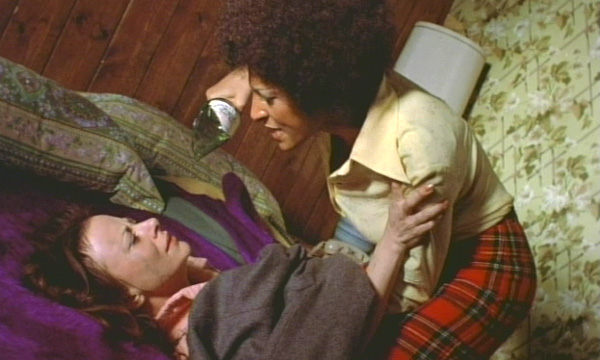
While all three of these films share a common theme within their main characters - the struggle for justice in a patriarchal world - it is the first film in Hill’s femsploitation niche, Coffy, that exhibit’s the most defined conventions of the femsploitation genre within a single female protagonist. Coffyis about a woman with the same name (Pam Grier) who systematically murders the members of a heroin empire, from the lackeys to the head honcho, after her eleven year old sister acquires brain damage because of a bad batch of heroin she accidentally came into contact with. And, while Coffy is totally in control of her actions and knows what she’s doing in terms of murdering each male figure in the empire, she also has a conscience that keeps her character from feeling too bombastic or devoid of feeling. In fact, her character feels quite the opposite - she feels more and more humane with each murder she commits because of the obvious physical and emotional effects it brings forth for her. Though she knows in her heart of hearts that what she’s doing is the right thing to do, she, nevertheless, hesitates a little more each time she has to pull the trigger or knife someone in the gut. So, by the time the film ends and she’s killed approximately twenty men, we empathize entirely with her because we as an audience have physically felt her entire emotional structure shift in more ways than I can count. After all, taking down an entire heroin empire single-handedly is pretty daunting.
However, these emotional shifts do not detract from the empowerment of Coffy’s character. While certain films would use this filmic platform to exhibit a woman who transitions from a strong, fierce woman to a simpering, blubbery mess throughout the course of the film, as it does in, for instance, the pre-code film, Female (1933) or Lubitsch’s The Love Parade (1930), Coffy is always seen as a smart, sassy, and sexy woman who can flirt or fight her way through life and attain what she wants, which is probably the film’s greatest success.
Released in 1973, Coffy is very much of a film of the feminist movement because it is the first, if I’m not mistaken, film of the era to feature a lone female character rising to power by defeating the patriarchy within a male-dominated field. Though it’s widely considered to be one of the originators of the blaxploitation film genre, and it can certainly be determined that way, I think it fits in with more of the ideals of the feminist movement because of the reasons behind her actions - her little sister having her life ruined and physically damaged by a masculine industry and her mission to prevent other girls in the future from being affected, is a very womanly mission.
However, there is one major flaw within the narrative structure that largely contradicts the feminist reading of the film - Coffy never asks for or takes support from other women. Her lone wolf status is empowering for her as a singular character, but if we were to look at the film’s overall structure and gage who she actually fights with throughout the entire film, it’s the women who are the dominating force. She may kill the men, but she fights with the women - women who are jealous of her presence around their drug pusher boy friends and, in one particular sequence, literally pour a bloody alcoholic drink all over Coffy’s white dress and expose her breasts by tearing off the straps. And, while, Coffy does fight back and tear off an equal amount or more of their clothing in a spectacular ten-minute catfight during a party scene, she never tries to recruit them for her mission. There’s no sense of a feminine community within this particular Jack Hill universe.
Foxy Brown picks up the slack in that regard except it does it in the worst possible way. During the second wave of the feminist movement, all of the organizations that were founded to support the mission, such as NOW and the Ms. Foundation, excluded lesbians from the scene because they thought the inclusion of fighting for gay rights as well as women’s rights would detract from their feminist objective. These sentiments are clearly expressed in all three of Jack Hill’s femsploitation flicks, but none are so strong thematically as in Foxy Brown, where there’s literally an elongated fight at a gay bar between Pam Grier and several stereotypically butch lesbians over one of Pam Grier’s female friends. The lesbians in Foxy Brownor should I say, the “fat, pig dykes” as the main character in Switchblade Sisters so eloquently spouts, are the dumb-jock, dumb-hick equivalents of the men who go after women in other exploitation movies – they’re one-dimensional characters, ahem, stereotypes, that are just looking for the next piece of ass to rape.
This is incredibly odd considering how progressive the films are in accordance to their racial and gender politics. Grier herself, now a gay icon and a cast member on The L Word, fails to address the problem, as expressed in a recent interview with her by one of Washington D.C.’s GLBT newspapers, The Metro Weekly. The interviewer asks:
“I know that both as a kid and as an adult I found myself attracted to this image you've had. What was it about you or your persona that drew that attention? Not every actress gets that kind of gay allegiance.”
Grier responds:
“I don't have a crystal ball, but it could be the fact that [those characters] fight -- she puts her neck out on the line for others. She's not a sacrificial lamb, but she will walk through the fire. She always fought for the underdog, and didn't take a lot seriously -- but what was supposed to be taken seriously, I did and the character did.
We didn't have a lot of women on screen then fighting for the underdog. In our communities we did, but it was never reflected on screen. Thank God, American International Pictures and [Coffy and Foxy Brown director] Jack Hill had this great respect for women and sexuality.”
But is that enough to warrant such blatant homophobia? I don’t think so and I don’t think Jack Hill does either. Because in his final foray into femsploitation territory, the 1975 flick Switchblade Sisters, Hill cuts down on the snarling stereotypes considerably and ups the female ante by creating the most empowering feminist film of his career. In the universe of the film, there are two gangs – the Silver Daggers (the male group) and the Dagger Debs (the female sub-group). The Debs, who, even though they have their own gang, are still buried underneath the masculinity of their male masters, the Silver Daggers because the Deb’s leader, Lace (Robbie Lee) is madly in love with the Dom (Asher Brauner), the leader of the male gang. She enjoys playing housewife to his manhood, which enables Dom to keep the Silver Daggers in a higher class above the Dagger Debs. That all changes when Maggie (Joanna Nail), the feisty, forthright feminist with big ideas struts into town with her thigh-high black boots and deadly belt and takes over the operation because of her moralistic values.
In my mind, the film could be seen as a metaphor for the battle of differences between the two political parties of the suffragist movement and the first wave of feminism – the NWP (National Woman’s Party) and NAWSA (National American Woman Suffrage Association). NAWSAwas the old-hat organization started by women, like Carrie Chapman Catt, who wanted to fight for suffrage on a state-by-state basis, which would have ultimately culminated into nothing because they weren’t being active participants in their fight. The NWP, first known as the Congressional Union for Women’s Suffrage (CUWS), was started by women like Alice Paul and Lucy Burns, who were people that actually wanted to go out and accomplish something instead of just sitting around and waiting for it to happen.
Though the battle between the two organizations didn’t end their feud in a cinematic knife fight as Maggie and Lace did in Switchblade Sisters, the film and the organizations do have striking thematic similarities. Maggie is the Alice Paul/NWP of the film universe and Lace represents women like Carrie Chapman Catt and NAWSA, in the sense that Lace stands for the old, torpid ideals of femininity. Maggie, like her counterpart Alice Paul, sees the patriarchal cloud hanging over her head when she joins the Dagger Debs and decides to do something about it by going after the rival male gang and winning the victory all on her own by using her ideas, wit, and craft to make it happen. The women in the gang gradually flock to her as their leader because she treats them with respect and dignity. This is very similar to both Alice Paul’s rise to leadership as well as some of her methods in acquiring the right for a woman to vote. For instance, in 1916, after Woodrow Wilson reneged on his commitment to the suffrage movement by not passing what is now known as the nineteenth amendment, Paul organized a twenty-four hour, seven-day a week picketing of the White House. Women stood outside with signs that said “Mr. President, how long must women wait for liberty?” and “Mr. President, what will you do for women’s suffrage?” Those two lines are similar in spirit to Maggie’s last line in the film:
“No, let me give you some advice, cop. You can beat us, chain us, lock us up. But we're gonna be back, understand? And when we do, cop, you better keep your ass off our turf, or we'll BLOW IT OFF! Ya dig? We're Jezebels, cop - remember that name. We'll be back! “
While all three of these films are categorized under the “exploitation” genre because of their inclusion of graphic female nudity and explosive violence on screen, I don’t think that Jack Hill is exploiting these women in the same way, say Russ Meyer exploits his women. Jack Hill uses exploitation elements, like the unnecessary breast action in Foxy Brown, to distinguish the differences between his female protagonist and the other women in the film. The same application can be applied to his use of rape, misogyny, and violence – he’s utilizing their inherent power to show the audience how they effect his women, not how they affect the audience. Therefore, I think the term “femsploitation” is more of an appropriate title to give the films of Jack Hill because he’s doing the same thing with the feminist themes by combining them with the exploitation fundamentals – showing how they’re used to give them more meaning.
Though he started making films in the mid 1960’s, Jack Hill has only completed sixteen films to date, Switchblade Sisters being his penultimate film. He hasn’t directed a film in twenty-five years. His films may contain a certain amount of material I disapprove of, like the blatant homophobia, I’d be hard-pressed to recommend a better male filmmaker after the fall of the studio system who so lovingly engrained powerful female characters into our public consciousness like he did. Coffy, Foxy Brown, and Switchblade Sisters are all films whose themes revolve entirely around women, their plights, and the feminist sensibilities that allowed them to be there in the first place.
Tuesday, September 16, 2008
Save BITCH!!!!!

Hey everyone!!!
Bitch magazine, the best magazine around, needs YOUR donation! If they don't have $40,000 by 10/15/08, then, sadly, Bitch will cease to be no more. It's hard out there for a non-profit magazine, so please donate anything you can! Even $5.00 will help. You'll even get your name in the magazine! And, I will love you forever.
~Sara
Subscribe to:
Posts (Atom)